
Introduction
A strong Career Episode does more than describe an engineering project. It demonstrates how the applicant applied engineering knowledge, made technical decisions, managed risks, solved problems and verified the outcome.
This distinction matters. A project may have been technically impressive, but the Career Episode will remain weak if it mainly explains what the company or project team achieved. Engineers Australia needs to understand what the applicant personally did and how those actions demonstrate the competencies required for the nominated engineering category.
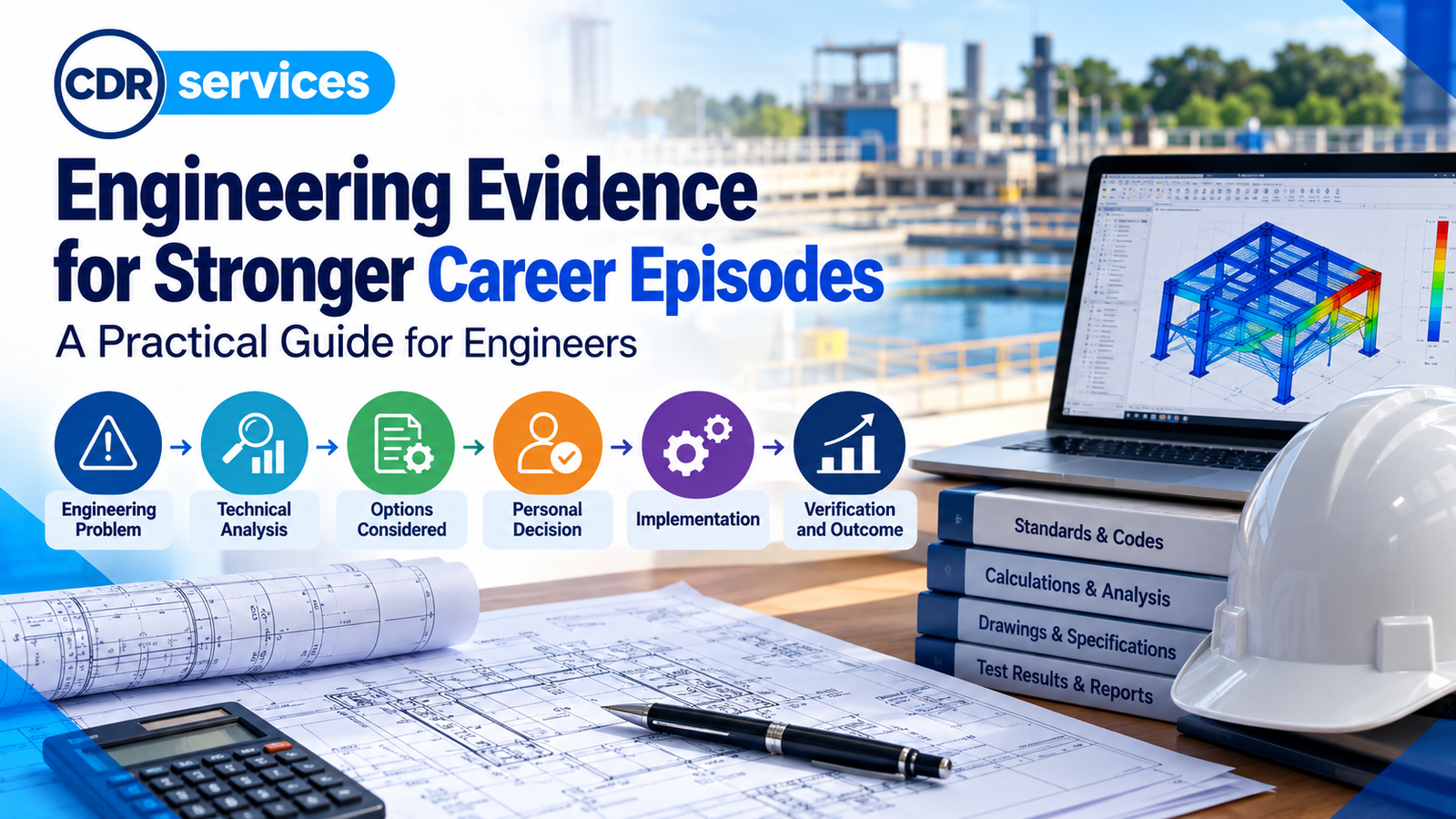
The most persuasive evidence normally follows a traceable sequence: engineering problem, technical analysis, options considered, personal decision, implementation and verification.
What is engineering evidence
Engineering evidence is the information that allows an assessor to understand and evaluate the applicant’s personal application of engineering knowledge. It is not limited to attachments, calculations or drawings. The written explanation is also evidence when it gives enough technical detail to make the contribution credible and understandable.
- The engineering problem personally addressed
- Technical data collected or reviewed
- Assumptions, limitations and design constraints
- Calculations, models or simulations completed
- Standards, codes and acceptance criteria applied
- Options compared and the basis for selection
- Safety, environmental and quality risks controlled
- Drawings, specifications or technical documents prepared
- Tests, inspections, reviews and measured results
- Lessons developed through the work
The objective is not to reproduce the complete project file. The objective is to select the strongest examples that demonstrate competence.
Project description compared with engineering evidence
| Project description | Engineering evidence |
| The project involved constructing a water treatment plant. | I calculated the peak treatment demand using the projected population, demand factors and seasonal variation. |
| The team selected a reinforced concrete structure. | I compared reinforced concrete and structural steel using loading, durability, fire resistance, construction time and lifecycle maintenance criteria. |
| Several design problems were encountered. | I identified excessive pipe pressure during transient analysis and revised the valve closure sequence to reduce the predicted surge pressure. |
| AutoCAD and ETABS were used. | I developed the structural model, defined the load combinations and compared critical reactions with an independent hand calculation. |
| The system was successfully commissioned. | I compared commissioning measurements with the design acceptance limits and confirmed that the operating pressure remained within the specified range. |
The evidence-based examples are stronger because they identify the applicant’s action, method, reasoning and result.
Also Read: Choosing suitable projects for your CDR Career Episodes
The five elements of strong engineering evidence
A clearly defined engineering problem
Strong evidence begins with a specific problem. A useful problem statement identifies the technical context, the information reviewed, the deficiency and the engineering consequence.
Weak example: The client needed a better drainage system.
Stronger example: I reviewed the survey data and identified that the existing drainage system could not convey the calculated peak runoff from the expanded catchment. My hydraulic assessment also showed that the upstream pit would surcharge during the design storm.
The consequence may involve inadequate capacity, unsafe operation, poor reliability, environmental harm, excessive cost, production losses or noncompliance with an applicable requirement.
Personal technical analysis
The largest part of a Career Episode should explain the applicant’s personal engineering activity. Team context is useful, but the assessor must be able to separate the applicant’s contribution from the work of colleagues.
- I calculated
- I analysed
- I modelled
- I designed
- I checked
- I selected
- I investigated
- I recommended
- I coordinated
- I verified
Weak example: We analysed the system and selected the most appropriate pump.
Stronger example: I established the design flow and static head from the approved process requirements. I calculated the system resistance for three operating scenarios and compared the required duty point with the manufacturer’s pump curves. Based on efficiency, available net positive suction head and operating flexibility, I recommended the second pump configuration.
Also Read: Engineers Australia MSA CDR requirements: a practical checklist
Engineering judgment and decision making
Calculations alone do not demonstrate the complete competency. The episode should show how technical information supported a decision. Explain the available options, comparison criteria, rejected alternatives and verification of the selected solution.
| Decision question | Evidence to include |
| What options were available? | Describe feasible technical alternatives. |
| Which criteria were used? | Technical performance, safety, compliance, constructability, cost, reliability and lifecycle needs. |
| Why were other options rejected? | State the relevant limitation or unacceptable risk. |
| Why was the selected option suitable? | Connect the decision to calculations, criteria and project constraints. |
| How was the decision confirmed? | Describe review, testing, inspection or measured performance. |
Verification and measurable outcomes
A strong Career Episode does not end when a design or recommendation is issued. It explains how the applicant checked whether the solution worked. Verification may involve independent calculations, design review, sensitivity analysis, inspection, commissioning, performance monitoring, laboratory testing or comparison with acceptance criteria.
If the first result was unsatisfactory, explain the discrepancy honestly. A technical problem that required investigation and correction can provide stronger evidence than an unexplained claim that everything worked perfectly.
Traceable personal responsibility
State the level of responsibility accurately. Explain whether the applicant completed the work independently, worked under supervision, checked another person’s work, prepared a recommendation, coordinated contractors, witnessed testing or managed a technical work package.
Working under supervision does not prevent an applicant from demonstrating competence. The episode can explain what was prepared, what feedback was received, how it was evaluated and what was revised.
A practical engineering evidence chain
| Evidence stage | What to explain | Questions to answer |
| Need | The engineering requirement | What performance, safety or compliance requirement had to be achieved? |
| Inputs | Data, assumptions and constraints | Which information did I use, and how did I confirm it was reliable? |
| Analysis | Calculations, models or investigations | What engineering method did I apply? |
| Options | Alternative solutions | What alternatives did I consider and compare? |
| Decision | Personal recommendation or selection | Why did I choose this solution? |
| Control | Safety, quality and environmental measures | Which risks did I identify and manage? |
| Implementation | Design, construction or operational action | How was my decision applied? |
| Verification | Testing, review or measurement | How did I confirm that the result was acceptable? |
| Reflection | Learning and professional development | What knowledge or competency did I develop? |
How much technical detail should be included
Include enough information for a technically informed reader to understand what was being determined, which inputs were used, why the method was appropriate, how the result was interpreted and what decision followed. It is not necessary to reproduce every line of a long calculation.
Weak example: I performed the load calculations and selected the correct beam.
Stronger example: I calculated the permanent, imposed and equipment loads and applied the required load combinations. My initial model satisfied the strength requirement but exceeded the serviceability deflection limit. I increased the section stiffness, reran the model and checked the revised deflection against the allowable value.
Also Read: Preparing a CDR for a priority or express timeline
Using equations effectively
Equations should support the explanation rather than replace it. Define variables and units, identify the source of inputs, explain assumptions, present the result and describe what the result meant for the project. An isolated formula provides little evidence without the engineering judgment surrounding it.
Related guide: How to structure a CDR Career Episode clearly
Demonstrating engineering software use
Listing software does not prove engineering competence. Explain why the tool was selected, how input data and boundary conditions were defined, how the output was checked and how the result influenced the decision.
Weak example: I used ANSYS to analyse the component.
Stronger example: I created the finite element model using the approved component geometry and material properties. I refined the mesh around the connection because I expected a local stress concentration. I applied the operating load and restraint conditions, reviewed convergence and compared the reaction forces with my hand calculations before accepting the model.
Showing the application of standards and codes
Simply naming a standard is not enough. Identify the applicable requirement, explain why it applied, show how it influenced the calculation or design and state how compliance was checked.
Weak example: I designed the structure according to AS 3600.
Stronger example: I used the applicable AS 3600 provisions to establish the strength and serviceability requirements. I checked the proposed slab for flexure, punching shear and deflection, then revised the reinforcement arrangement after the initial punching shear check was unsatisfactory.
Safety environmental and quality evidence
Safety should be integrated into the engineering activity rather than added as a generic paragraph. Connect each control to a specific hazard, failure mode or requirement.
| Evidence area | Examples of strong evidence |
| Safety | Hazard identification, guarding, access, isolation, temporary works, safe construction sequence and residual risk. |
| Environment | Waste, energy, water, emissions, noise, contamination, material selection and monitoring. |
| Quality | Inspection and test plans, acceptance criteria, calibration, traceability, design review and corrective action. |
Also Read: The final CDR review: consistency checks before submission
Communication as engineering evidence
Communication becomes competency evidence when it contributes to an engineering outcome. Examples include explaining a design risk, resolving conflicting technical requirements, coordinating discipline interfaces, answering a contractor’s technical query or presenting options to decision makers.
Weak example: I communicated with the project team.
Stronger example: I presented three drainage options using the hydraulic results, construction constraints and cost comparison. I explained that the lowest capital cost option retained an unacceptable flooding risk. The client accepted my recommendation to proceed with the higher capacity system.
What weakens engineering evidence
| Weakness | Why it creates a problem | How to improve it |
| Excessive background | The applicant’s work becomes difficult to find. | Keep employer and project history brief, then move to personal activity. |
| Repeated use of we | Personal contribution is unclear. | Use we for context and I for personal work. |
| Duty lists | Responsibilities are asserted but not demonstrated. | Add a specific technical example, method, decision and result. |
| Unsupported success claims | Words such as successful and excellent are not measurable. | Provide tested, measured or documented outcomes. |
| Software screenshots | The model setup and understanding are unknown. | Explain inputs, assumptions, checks and interpretation. |
| Unexplained equations | Mathematical activity is shown without engineering judgment. | Connect the calculation to a decision. |
| Generic safety claims | No actual hazard or control is demonstrated. | Describe the identified risk and engineered control. |
| Copied competency wording | The episode states competence rather than proving it. | Describe real engineering work and map it later in the Summary Statement. |
Weak and strong Career Episode examples
| Weak statement | Stronger evidence-based version |
| I designed the electrical system. | I calculated the connected and maximum demand loads, developed the load schedule and selected the transformer capacity after checking normal operation and future expansion. |
| I solved several technical problems. | I traced the recurring motor trip to voltage imbalance by comparing phase measurements under different operating conditions. |
| I managed project risks. | I recorded the excavation collapse risk, reviewed the soil information and recommended temporary shoring before personnel entered the excavation. |
| I used engineering software. | I developed the hydraulic model, calibrated it against recorded pressure data and tested three network upgrade options. |
| I ensured quality. | I reviewed the material certificates, witnessed the pressure test and compared the recorded pressure and hold time with the approved acceptance criteria. |
| I supervised the contractor. | I inspected the reinforcement before concrete placement, identified inadequate lap lengths and issued a corrective instruction supported by the approved drawings. |
| I improved efficiency. | I revised the operating sequence and reduced average cycle time from 14 minutes to 11 minutes during the verified production trial. |
Selecting projects with strong evidence potential
Choose projects that allow a credible explanation of personal engineering work. Before selecting a project, confirm that you can explain the technical problem, calculations or analysis, options, decisions, risks, outputs and verification accurately.
| Career Episode | Recommended emphasis |
| Career Episode 1 | Engineering design and technical analysis |
| Career Episode 2 | Construction, implementation, commissioning or project delivery |
| Career Episode 3 | Investigation, optimisation, research, failure analysis or asset improvement |
Avoid selecting three nearly identical projects. The set should demonstrate a useful range of competencies without inventing activities.
A useful paragraph structure
- Situation: identify the specific engineering issue.
- Action: explain what you personally did.
- Technical basis: describe the calculation, standard, model or analysis.
- Decision: explain what you selected or recommended.
- Result: state how the outcome was checked.
Example: During my review, I identified that the proposed cable size produced an unacceptable voltage drop at peak load. I recalculated the circuit using the maximum demand, route length, installation method and conductor temperature. I compared two larger conductor sizes and checked current carrying capacity, voltage drop and fault performance. I selected the larger option because it satisfied the operating and future load requirements. I updated the cable schedule and confirmed the revised design during the final electrical review.
Integrity guidance: CDR authorship, originality and plagiarism risks
Maintaining authenticity and integrity
Career Episodes must be based on the applicant’s own engineering work and must accurately describe the applicant’s contribution. Engineers Australia’s January 2026 guidance identifies plagiarism, fake documents, misleading information and third party authorship of Career Episodes or the Summary Statement as unethical conduct that can lead to rejection and a ban on reapplying.
- Write from your own project records and memory.
- Use genuine calculations, decisions and outcomes.
- Do not copy another applicant’s Career Episode.
- Do not purchase recycled project narratives.
- Do not invent standards, software, results or responsibilities.
- Do not exaggerate decision making authority.
- Check dates against the CV and employment evidence.
- Protect confidential information without making the account unverifiable.
- Use professional review to improve clarity and identify gaps, not to replace personal authorship.
Also Read: CDR Summary Statement mapping without unsupported claims
Final Career Episode evidence checklist
Project context
- Project dates, location, organisation and position are clear.
- The project objective and scope are explained.
- The applicant’s position within the team is understandable.
Personal engineering activity
- First person language is used consistently.
- Personal work can be separated from team activity.
- Calculations, models or investigations are explained.
- Standards and criteria are connected to decisions.
- Alternatives and the basis for selection are visible.
- Safety, environmental and quality risks are addressed through specific controls.
- Communication is demonstrated through real engineering interactions.
- The result is tested, measured, reviewed or otherwise verified.
Evidence quality
- Inputs, methods and outcomes are credible.
- Units and technical terms are used correctly.
- Important claims can be supported by genuine project records.
- Generic competency statements and irrelevant background have been removed.
- Paragraphs are numbered for Summary Statement mapping.
- The content is truthful and based on the applicant’s own work.
Also Read: How to respond to an Engineers Australia information request
Conclusion
Strong engineering evidence is specific, personal, technical and verifiable. It shows what the applicant analysed, why a method was selected, how risk was controlled, what decision was made and how the result was confirmed.
The strongest Career Episodes do not depend on impressive project names or complicated terminology. They provide a clear and credible record of engineering judgment. Before writing, assemble calculations, drawings, reports, standards, decisions and verification records. Build each episode around the engineering problems personally addressed, then complete the Summary Statement after the evidence is stable and the paragraphs are numbered.
Official sources
- Engineers Australia Migration skills assessment
- Prepare your Migration Skills Assessment application January 2026
- How to write Career Episodes and a Summary Statement
CDR Services disclaimer
This article is provided for general educational purposes. CDR Services is an independent engineering documentation support provider and is not affiliated with Engineers Australia. Assessment and migration outcomes are not guaranteed. Applicants must submit truthful evidence based on their own qualifications, projects, decisions and experience.